
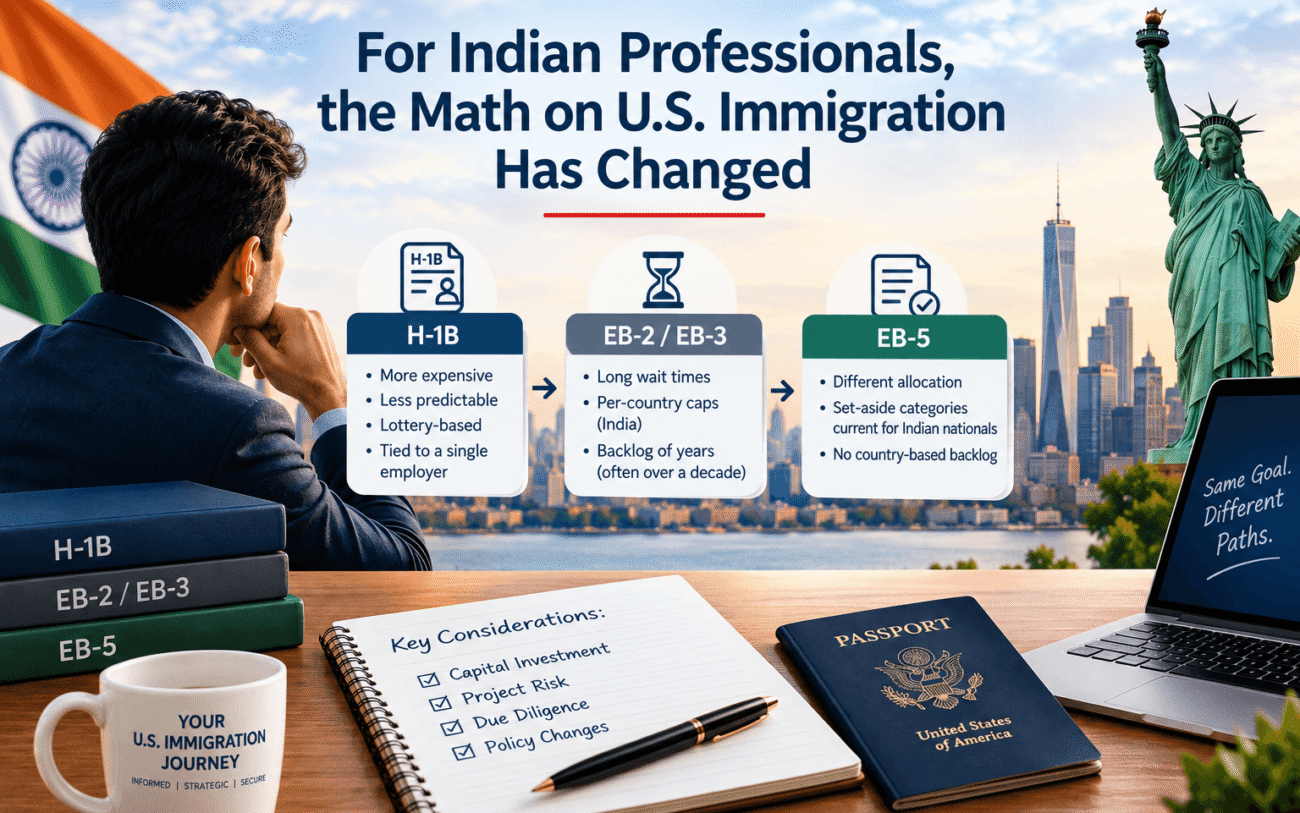
For Indian Professionals, the Math on U.S. Immigration Has Changed
For years, the conventional path to a U.S. green card for many Indian professionals ran through an employer: an H-1B petition, then years of waiting inside the employment-based system for a visa number to become available. That path still exists, but the ground underneath it has shifted, and it’s worth pausing on what that shift actually means before assuming it’s still the default option.
Start with H-1B. It was never simple, but it has gotten more expensive and less predictable. Selection is still a lottery, and recent changes have added steep new costs to new petitions on top of that uncertainty. Even for those who are selected, the visa itself is tied to a single employer, which means a layoff or a company decision can put years of planning at risk overnight.
Then there’s the wait that follows H-1B for those pursuing an employment-based green card. Because of per-country caps that treat India the same as far smaller countries, and because so many Indian professionals apply for these categories, the backlog for EB-2 and EB-3 green cards has stretched into years, in many cases well over a decade. That wait has nothing to do with an individual’s qualifications. It’s a structural bottleneck built into how the numbers are allocated by country of birth, and it affects highly qualified applicants just as much as anyone else.
This is part of why EB-5 has become a serious option for so many Indian families, not as a shortcut, but as a genuinely different structure. Investment-based visas are allocated differently than employment-based ones, and as of now, the reserved, set-aside categories under EB-5 remain current for Indian nationals, meaning there is no country-based backlog sitting in front of them the way there is in EB-2 and EB-3. That is a meaningful structural difference, not a guarantee about the future, and it’s worth understanding on its own terms rather than as a footnote to the H-1B conversation.
There’s another piece of this that often gets overlooked. Many of the families weighing EB-5 already have a son or daughter in the U.S. on an F-1 student visa, and that status comes with its own quiet countdown: the OPT clock, the H-1B lottery they’ll eventually have to hope to win, and the constant work of maintaining status while finishing a degree or starting a career. EB-5 works differently. A qualifying investor’s spouse and unmarried children under 21 are included as derivatives on the same petition, so a family pursuing EB-5 often isn’t just addressing the parents’ immigration question, it’s resolving that F-1 uncertainty for their child at the same time. One decision, two problems solved.
None of this makes EB-5 automatically the right choice. It carries its own considerations: a real capital investment, project-specific risk, and a process that rewards careful diligence over speed. And immigration policy of every kind, including EB-5, is subject to change without much warning, so nothing here should be read as a permanent state of affairs.
What we would encourage is simply this: don’t evaluate EB-5 by comparing it to how things worked five or ten years ago, and don’t assume the H-1B and employment-based route is still the fastest or most reliable path just because it once was. The comparison worth making is current conditions against current conditions, for your specific situation, with current information. For many Indian professionals and their families, that comparison looks different today than it did even a few years ago, and it’s worth taking the time to understand why.
Singletary Law Group is a U.S.-based law firm with an office and staff on the ground in India. We work with clients across all of these pathways, EB-5 included, and we’re glad to help you think through which one actually fits your circumstances.